Cosmic Insights
Saturn Return Explained: Ages, Meaning and What to Expect

A Saturn return is one of astrology’s best-known timing cycles. It describes the period when transiting Saturn returns to roughly the same zodiac position it occupied at your birth. Astrologers often associate it with responsibility, structure, limits and long-term decisions.
What is a Saturn return?
Saturn takes about 29.5 years to orbit the Sun. In astrology, that means most people experience a first Saturn return around ages 28–30, a second around 58–60 and, for those who reach it, a third around the late 80s.
Why the dates are not identical for everyone
Your exact Saturn return depends on Saturn’s natal degree and the planet’s current motion. Retrogrades can cause Saturn to cross the natal degree more than once, so the experience may unfold across several months rather than one day.
First Saturn return
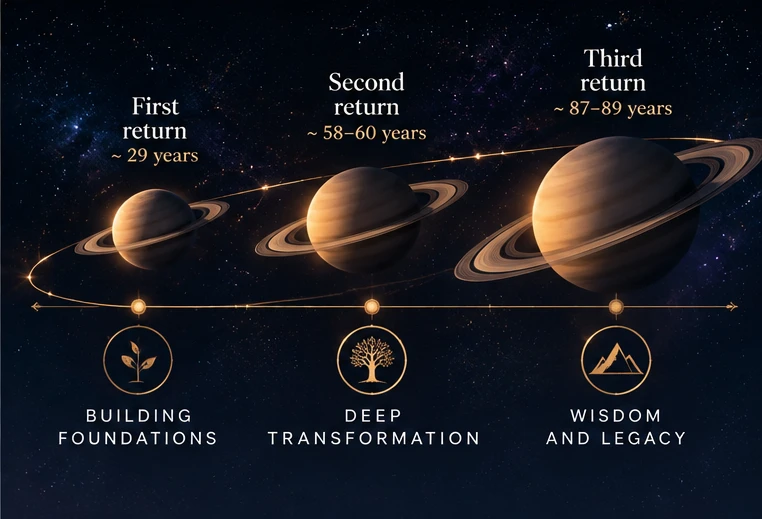
The first return is often interpreted as a transition into a more self-directed adult structure. Career choices, relationships, home, finances and boundaries may become areas of deliberate evaluation.
Second Saturn return
The second return is commonly framed around legacy, sustainability and whether existing commitments still reflect current priorities. The emphasis is less about “starting adulthood” and more about editing the structures built over previous decades.
Saturn return by house

The natal house containing Saturn can help astrologers focus the interpretation. Saturn in the 2nd may emphasize resources and values; in the 7th, partnerships; in the 10th, career and public responsibility. The whole birth chart still matters.
What a Saturn return does not mean
Astrology does not establish that a Saturn return causes specific life events. Treat the cycle as a symbolic framework for reflection rather than a prediction that something difficult must happen.
How to find your Saturn return
- Generate a natal chart using your accurate birth date, time and place.
- Note Saturn’s sign and exact degree.
- Check an ephemeris or astrology software for when transiting Saturn reaches that degree.
- Include retrograde passes if they occur.
Saturn return and real-life decisions
Astrologers commonly associate the cycle with work, commitment and responsibility. In practice, you can use the idea as a reminder to check your budget, examine a long-term goal, and discuss shared expectations. These are sensible planning habits at many ages, regardless of astrology.
Finding your exact Saturn return
Find Saturn’s sign and degree in your birth chart, then compare it with an ephemeris. Saturn’s apparent retrograde motion can create several crossings. Your birth time is especially helpful for house placement. Learn more about the 12 birth chart houses before interpreting a house-based return.
What does a second Saturn return mean?
Traditional astrology associates the second Saturn return, often around ages 58 to 60, with revisiting commitments established during earlier decades. People may be considering career transitions, retirement planning, family responsibilities or personal interests. Those changes have many real-world causes; astrology is only one optional framework for reflection.
How to plan a Saturn return reflection
Start by listing current responsibilities and deciding which ones still matter. Review your finances, health routines and work commitments with appropriate experts. Choose one manageable goal and a date to review progress. Avoid treating ordinary setbacks as cosmic punishment; focus on choices you can influence and support you can access.
See our birth chart houses guide for context.
Saturn return planning checklist
Use a journal to review your long-term goals, current commitments and priorities. Choose one small change that you can measure. A Saturn return is an astrological interpretation, not a scientific prediction. Consider your circumstances before making important decisions.
Saturn return FAQ
At what age does the first Saturn return happen?
Most people experience it around ages 28 to 30, but exact timing depends on Saturn’s position in the natal chart.
How long does a Saturn return last?
Its symbolic period can span several months, especially when apparent retrograde motion produces multiple crossings of the natal Saturn degree.
Does everyone experience a second Saturn return?
People who reach approximately ages 58 to 60 generally experience the corresponding astronomical cycle.
Is a Saturn return always difficult?
No. Astrology does not reliably predict personal events. Interpretations vary, and life transitions have many practical causes.
Can I calculate a Saturn return without my birth time?
A birth date may help estimate Saturn’s zodiac position, but an accurate time is important for interpreting astrological houses.
Does Saturn return determine career or relationship outcomes?
No scientific evidence shows that it determines outcomes. Base major decisions on evidence, your circumstances and appropriate professional advice.
Bottom line
A Saturn return is best understood as a multi-month astrological cycle centered on structure, responsibility and long-term choices. Exact timing comes from your natal Saturn degree, not age alone.
Focus keyword: Saturn return explained